
Heat Pump Water Heaters for Domestic Hot Water: How They Work and When They Make Sense
Domestic hot water is a constant household energy demand, whatever the season. Showering, washing dishes and other everyday activities require repeated heating of substantial amounts of water, and the method used can affect overall household energy consumption.
One option is a heat pump water heater, which uses thermal energy from the air to produce domestic hot water. Unlike a conventional electric water heater, which generates heat directly through a resistance element, it transfers existing heat from the air into the water stored in its tank.
Below, we explain how a heat pump water heater works, its main components, how efficient it can be and what to consider before choosing one.
What is a heat pump water heater?
A heat pump water heater is designed primarily to heat and store domestic hot water. Typically, a storage tank and a heat pump circuit that extracts thermal energy from the air are integrated into the same appliance.
The operating principle is similar to that of other heat pumps: rather than merely converting electricity directly into heat, the system uses electricity to run a process that collects heat from the surrounding environment and transfers it to the water.
It is also important to distinguish a self-contained heat pump water heater from a hot water cylinder connected to a separate heat pump that heats the home.
In the first case, the heat pump is built into the water-heating appliance.
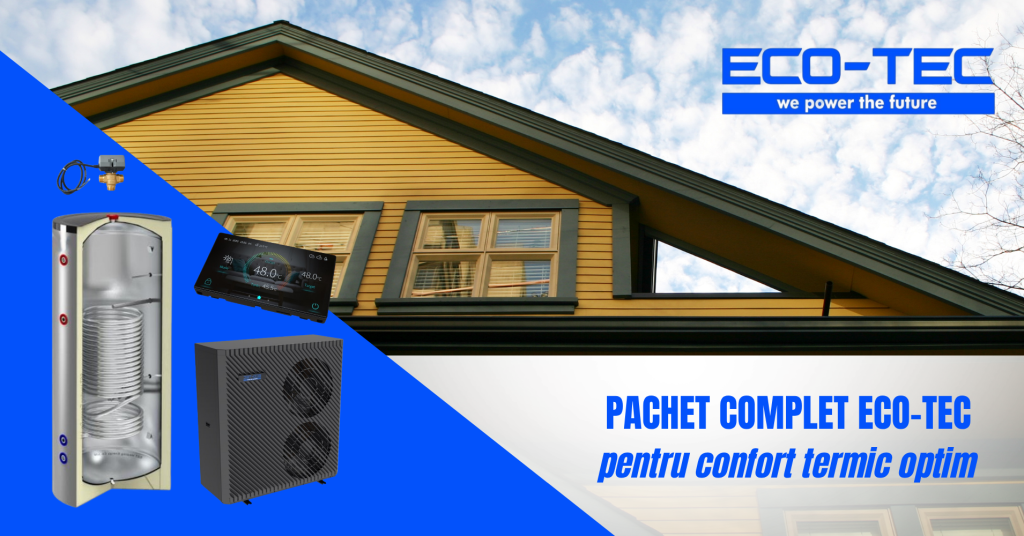
In the second case, the cylinder is mainly a storage tank, heated by a separate heat pump. ECO-TEC also covers the selection of suitable hot water cylinders for heat pump systems, making this distinction particularly useful.
How does a heat pump water heater produce domestic hot water?
The process is easier to understand by following the energy flow. The appliance draws air from the room where it is installed or, depending on its configuration, through ducts connected to other areas. The heat contained in that air is then used to warm the water stored in the tank.
The process follows several stages:
-
Air is drawn across the evaporator. Even when the air does not feel warm, it contains thermal energy that the appliance can use within its rated operating limits.
- The refrigerant absorbs heat from the air. Inside the evaporator, this energy passes into the refrigeration circuit.
- The compressor raises the refrigerant pressure, increasing its temperature.
- Heat passes from the refrigerant to the stored water through the condenser.
- The refrigerant returns to the conditions required to repeat the cycle, which continues until the water reaches the selected temperature.
- The compressor, evaporator, condenser and refrigerant are fundamental elements of the heat pump operating cycle.
Why does it use less energy than a conventional electric water heater?
The key difference lies in how the two appliances produce hot water.
A conventional electric water heater uses a resistance element to heat water directly. A heat pump water heater uses electricity mainly to operate its compressor, fan and controls, while drawing a substantial share of the required heat energy from the air.
Heat pump performance is often described by the coefficient of performance, or COP.
For example, a COP of 3 means that under specified test conditions the system can provide approximately 3 kWh of heat for every 1 kWh of electricity consumed. However, COP is not constant. Air temperature, the desired water temperature and the specific appliance all influence actual performance.
The ECO-TEC team recommends evaluating declared efficiency together with tank volume, household hot water demand and the real operating conditions when selecting a heat pump water heater.
What are the advantages of a heat pump water heater?
The main advantage is energy efficiency. In a household that uses hot water regularly and in consistent amounts, the difference in electricity consumption compared with resistance-only heating can become significant over time.
A heat pump water heater also offers several practical advantages:
- it uses energy available in the air to prepare domestic hot water;
- it can reduce the electricity required for hot water compared with a conventional electric water heater;
- no fuel is burned within the appliance;
- it stores hot water so it is available when needed;
- it can suit households seeking to electrify their energy use and improve efficiency.
These benefits must be weighed against the initial investment and installation conditions. In its comparison of heat pump water heaters and conventional electric heaters, ECO-TEC likewise highlights the trade-off between a higher purchase cost and potentially lower running costs.
How much electricity does a heat pump water heater use?
Electricity consumption depends on the amount of hot water used, the selected temperature, operating conditions and tank capacity. The appliance should therefore be chosen according to the household’s actual hot water demand.
For example, the ECO-TEC BECP200-SAV is a 200-litre thermodynamic water heater with an air-source heat pump, stainless-steel tank and R290 refrigerant.
For systems with a separate heat pump, ECO-TEC also offers 200-, 300- and 500-litre hot water cylinders, making it possible to choose a capacity that matches water demand and the installation layout.
Where can a heat pump water heater be installed?
The installation location matters more than it does for a conventional electric water heater. The heat pump needs access to sufficient air, and the air discharged after heat extraction will be cooler.
Depending on the model and system layout, a plant room, basement, garage or another suitable space may be considered. The manufacturer’s requirements for room volume, airflow, permissible temperatures and any necessary ductwork must be respected.
This should not be overlooked. Unsuitable positioning can affect efficiency and comfort in the surrounding room. ECO-TEC’s materials on heat pump water heating also emphasise the need for a suitable, well-ventilated space.
How do you choose the right tank capacity?
Tank capacity should be based primarily on the actual amount of hot water used and the number of occupants. Automatically selecting the largest available cylinder is not necessarily a good approach.
Consider household habits, the number of bathrooms, simultaneous use of multiple outlets and the times of day when hot water demand peaks.
An undersized tank may run short during periods of intensive use. A substantially oversized tank, by contrast, means heating and keeping a quantity of water warm that may never be needed.
A heat pump water heater should therefore be sized around real household use, not just the floor area of the home.
Heat pump water heater or conventional electric water heater?
Both options meet the same need, but use different technologies.
A conventional electric water heater offers simpler construction, a lower upfront investment and generally easier installation. It may still be suitable where hot water use is low or the initial budget is the main deciding factor.
A heat pump water heater costs more to purchase and requires more careful installation, but uses electricity more efficiently. That difference is particularly meaningful when hot water is used consistently over many years.
The decision should be based on total cost of ownership, not the purchase price alone. ECO-TEC’s comparison uses the same criteria: efficiency, initial cost, installation, maintenance and electricity consumption.
Is a heat pump water heater worth it for domestic hot water?
It can be an excellent choice when hot water consumption is regular, suitable installation space is available and the goal is to reduce electricity use over time.
However, it is not automatically the best option for every home. Before buying, assess the required hot water volume, available space, expected air temperatures, upfront cost and the technical specifications of the chosen model.
For new buildings and renovation projects, considering these factors at the design stage helps ensure correct sizing and avoid an unsuitable purchase.
To select a solution suited to your household, explore ECO-TEC heat pumps, water heaters and accessories, or request technical advice tailored to your project.
